Available courses

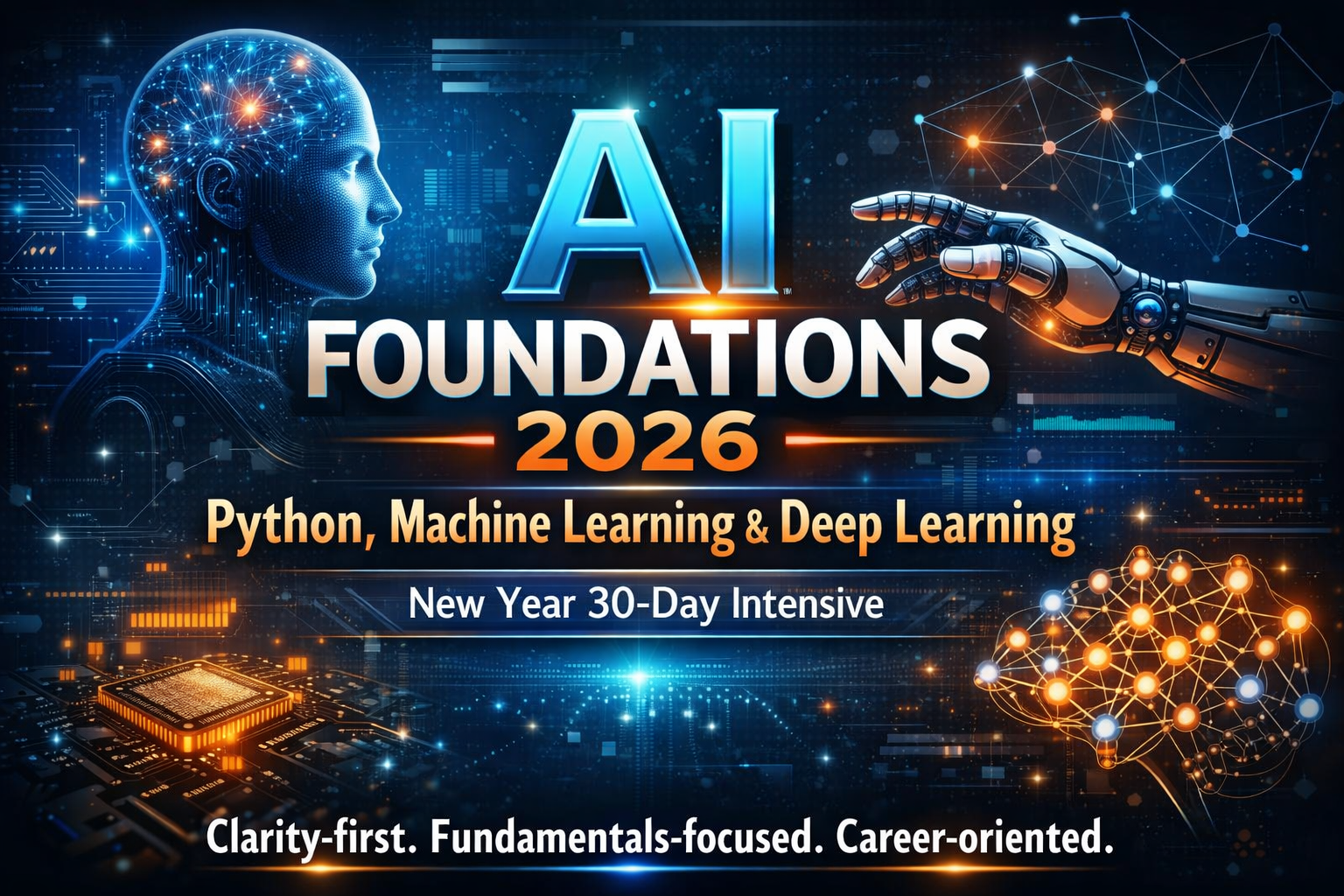
🔥 AI Foundations 2026

Python, Machine Learning & Deep Learning

New Year 30-Day Intensive
Clarity-first. Fundamentals-focused. Career-oriented

AI Foundations 2026 is a 30-day New Year intensive program designed for learners who want to build strong fundamentals in Python, Machine Learning, and Deep Learning — not just memorize tools or rush through content.

This is not a bootcamp and not a crash course.

Instead, the program focuses on:

  • Conceptual clarity

  • Real-world intuition

  • Hands-on coding

  • Interview-ready understanding

Each topic is taught at a realistic, industry-aligned depth, allowing learners to truly understand why models work — not just how to use them.


🎯 Who This Course Is For

  • Beginners starting their AI / ML journey in 2026

  • College students seeking strong foundations

  • Working professionals transitioning into data roles

  • Anyone tired of superficial AI tutorials


⏱️ Program Structure

  • Duration: 30 Days

  • Format: Live online sessions

  • Daily Time Commitment: 1 Hour

  • Approach: Concept → Intuition → Coding → Interview Context

Each session includes:

  • Live explanation with examples

  • Guided hands-on coding

  • MCQs and interview-style questions

  • Assignments & mini practice tasks


🧠 What Makes This Different

✔ Foundation-first (not tool-first)
✔ Structured progression: Python → ML → DL
✔ Industry-relevant algorithms only
✔ Realistic learning pace (1 hour/day)
✔ End-to-end ML & DL mini projects
✔ Interview clarity built into teaching


👨‍🏫 Instructor

Chaitanya Desai
IIT(Data Science)


🧩 Learning Outcome

By the end of this program, learners will:

  • Think confidently in Python

  • Understand how ML models actually work

  • Build and evaluate DL models

  • Explain their projects clearly in interviews

  • Be ready to move into advanced AI / GenAI tracks


“AI Foundations 2026 is a clarity-first New Year intensive — built for learners who want strong fundamentals, not rushed bootcamps.”

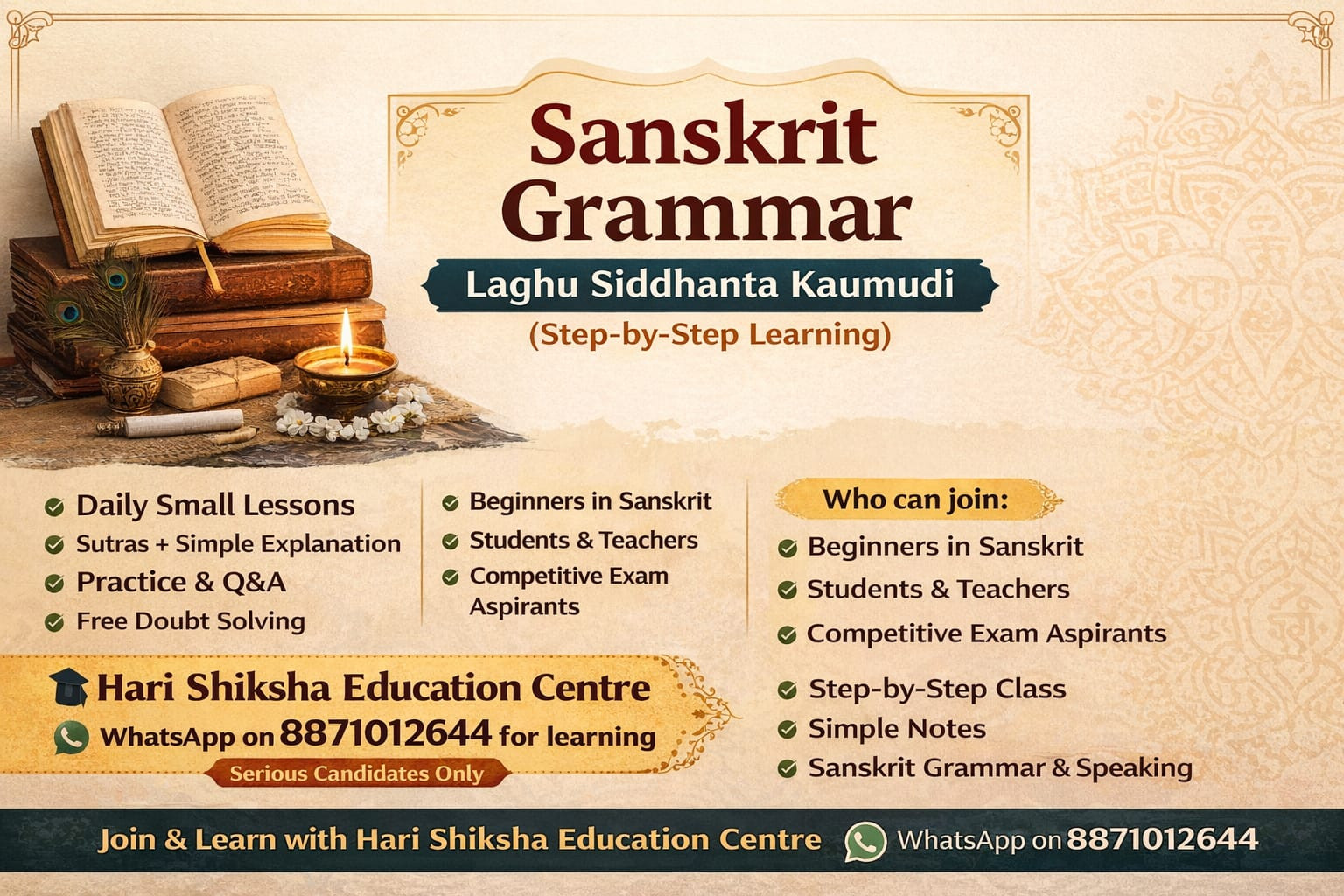
📘 Sanskrit from Scratch – Beginner Batch

🙏 Hari Shiksha Education Centre

🎯 Start Learning Sanskrit from Zero Level

👉 If you are:
* Complete beginner
* Forgot Sanskrit basics
* Want strong grammar foundation

This batch is perfect for you 👍

---

📚 What you will learn:

* Basic Sanskrit reading & pronunciation
* Simple words & vocabulary
* Sentence formation (एषः, सा, तत् etc.)
* Introduction to Sandhi (सन्धि)
* Basics of Samasa (समास)
* Pratyaya (प्रत्यय) & Upasarga (उपसर्ग)
* Simple grammar + daily speaking practice

---

🎓 Course Features:

* Step-by-step teaching (very simple method)
* Daily practice & examples
* Doubt clearing support
* Speaking + grammar connection

---

⏳ Course Duration: 30 session 

💰 Fee: 6000/- rs

---

🚀 In course you will learn:
* Sandhi (सन्धि)
* Samasa (समास)
* Pratyaya (प्रत्यय)
* Upasarga (उपसर्ग)

You will be ready for
👉 Laghu Siddhanta Kaumudi (LSK)

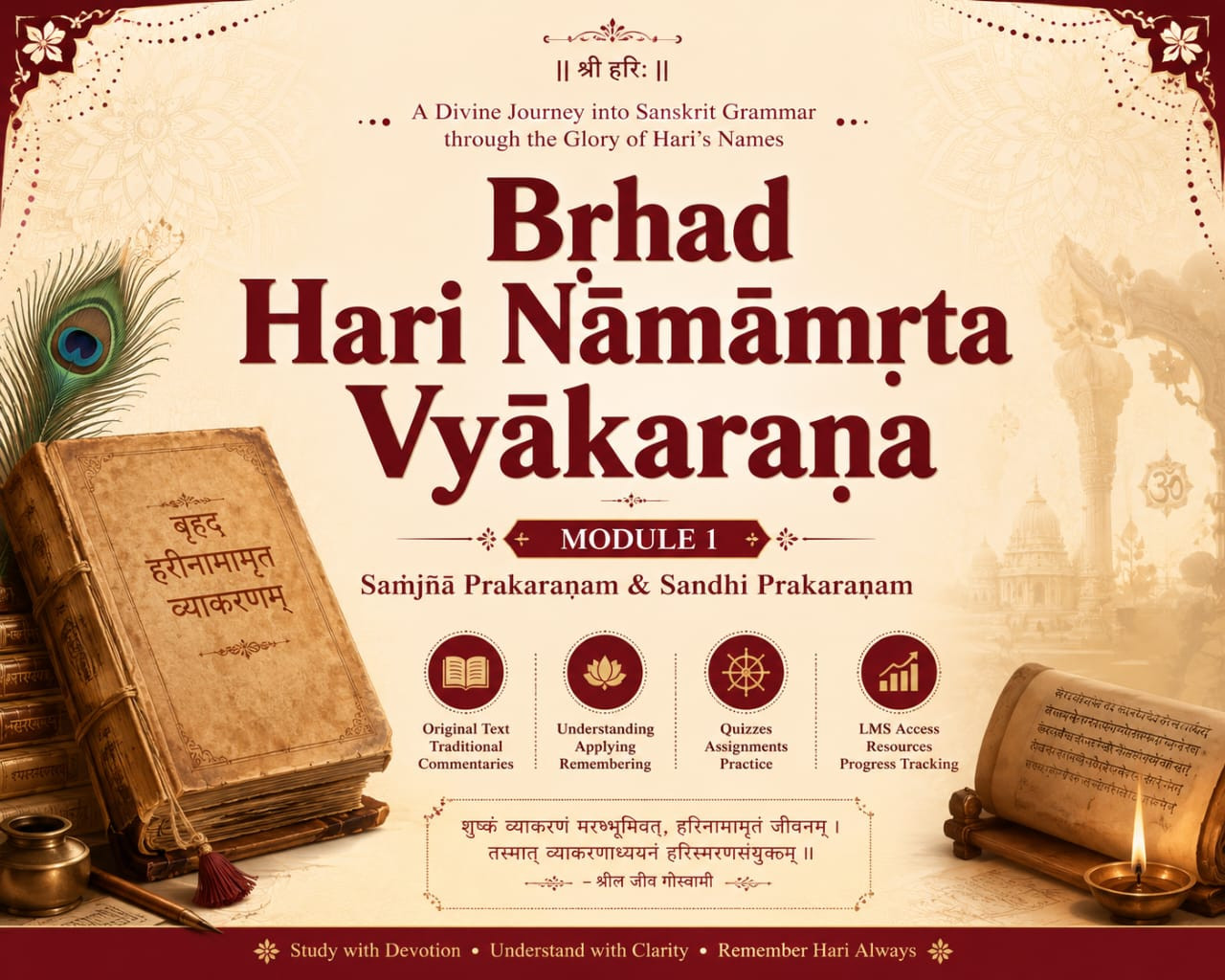
🌸 Inspiration for Our Hari Nāmāmṛta Vyākaraṇa Journey 🌸

«"I want to start a nice International Institute at the place of Srila Jiva Goswami.... My mission is develop the glories of Srila Jiva Goswami all over the world and I think you should cooperate with my honest endeavour."»

 — Śrīla A. C. Bhaktivedanta Swami Prabhupāda Letter to Śrī Nripendra Nath Banerji New York, 15 December 1966

After Module 1 (Saṁjñā Prakaraṇam & Sandhi Prakaraṇam), participants should be able to:

✅ Understand the fundamental technical terms (saṁjñās) used throughout Hari Nāmāmṛta Vyākaraṇa.

✅ Recognize and analyze the most common sandhis found in Sanskrit texts.

✅ Perform sandhi-viccheda (splitting joined words) with confidence in many common examples.

✅ Form sandhis according to the rules learned in the module.

✅ Read Sanskrit verses with greater accuracy by identifying where words have joined.

✅ Appreciate the devotional approach of Śrīla Jīva Gosvāmī, where grammar itself becomes connected with remembrance of Hari.

✅ Build a strong foundation for studying the later prakaraṇas of Hari Nāmāmṛta Vyākaraṇa.

FAQ:

1) Which version of Hari Nāmāmṛta Vyākaraṇa will be studied?

We shall study the original Bṛhad Hari Nāmāmṛta Vyākaraṇa by Srila Jiva goswami in Sanskrit, along with the English translation. The course will include below commentries/references to: - Vṛtti of Śrīla Jīva Gosvāmī - Bālāṭoṣaṇī by Śrī Harikṛṣṇācārya (later completed by Śrī Gopīcaraṇa Vedāntabhūṣaṇa, where applicable) - Amṛtāsvādinī-ṭīkā by Śrī Gopāla Dāsa - Selected references from Matsyāvatāra Prabhu's book, wherever helpful for additional clarity. In addition to the daily PPTs, the LMS will provide technical terminology, practice material, quizzes, assignments, and other resources to help build a clear understanding of the concepts.

2) Is memorization of all the sūtras expected?

No. The primary focus is to understand the sūtras and apply them correctly. Through daily collective recitation (pārāyaṇam), quizzes, assignments, topic-wise practice, and regular application during the classes, the sūtras will gradually become familiar and naturally easier to memorize.

Ab Initio Batch #46 – Course Overview

This comprehensive training program blends foundational data concepts with advanced Ab Initio development, SQL mastery, and UNIX scripting. It’s designed to equip learners with end-to-end data engineering skills through progressive modules and hands-on mini projects.


📅 Module Breakdown

Day 1: SDLC Fundamentals

  • Software Development Life Cycle basics

  • Project lifecycle understanding for data workflows

Days 2–5: Data Warehousing Concepts

  • OLTP vs OLAP

  • Star schema vs Snowflake schema

  • Dimensional vs ER modeling

  • Types of Facts and Dimensions

  • Slowly Changing Dimensions (SCD 0,1,2,3,4,6)

  • ETL architecture: ODS, Data Mart

  • Data types and normalization (1NF, 2NF, 3NF)

Days 6–11: SQL Mastery

  • SQL command categories: DML, DDL, DCL, TCL

  • Clauses: WHERE, CASE WHEN, EXISTS

  • Constraints and operators (math, relational, comparison, LIKE, IN, BETWEEN, AND/OR)

  • Set operators: UNION, UNION ALL, INTERSECT, MINUS/EXCEPT

  • Joins: natural, inner, left/right/full outer, semi, anti, self

  • Aggregation: GROUP BY, HAVING, ORDER BY

  • Functions: string, date, decimal, window functions

  • Performance tuning: indexing, partitioning, views

Ab Initio Core Modules

  • Architecture: GDE, EME, Co>Op, Conduct>It, Express>It, MetaHub, PDL, Query>It, BRE

  • Scheduling tools: Control-M, Control Center, Autosys, Jill scripts

  • Component types: Transform, Data, Continuous

  • Advanced topics: Partitioning/Departitioning, WMF, EMF, ICFF (WBC), Web services, JSON, vector flattening

  • Function library: string, date, decimal, regex, lookup, error handling, validation

  • Coding logic: variables (local/global), if-else, loops, lookup chaining, vector functions, temp variables, multistage transforms

  • DML writing styles (5 types)

  • Performance tuning with MFS

  • PDL and metaprogramming

  • Conduct>It planning and looping

Data Governance & Lineage

  • Data dependency tracking

  • Lineage visualization

  • Governance principles

  • Express>It integration


🛠️ Mini Projects & Applied Logic

  • FBE & REF: Data cleansing and redirection

  • Lookup Project: Transform logic implementation

  • Join Project: SCD1 and SCD2 modeling

  • Normalization Project: Inventory management schema

  • Lookup + Partitioning: Mini project on performance optimization


🖥️ UNIX Essentials (3–4 Days)

  • Core commands: cd, cp, rm, mv, sort, uniq, paste, pwd

  • Text processing: grep, egrep, sed, awk, find, ps -elf

  • Shell scripting fundamentals


🚀 Deployment & Automation

  • AIR and M commands

  • Code migration: Dev to Prod

  • Conduct>It continuous components:

    • File watcher → Graphs → Purging/Cleansing/Housing

    • Row-to-column and column-to-row transformations

    • MetaPivot and Normalize for reshaping data

    • Rollup and accumulation for denormalization

    • Row suppression and aggregation logic


Site announcements

There are no discussion topics yet in this forum.